
Mapping the Fieldwork Toolkit
Ten Competencies for Inclusive Learning Design

If you’ve been following along, you know that this work doesn’t fit neatly into a single box. Inclusive learning design calls on us to balance technical systems, ethical foundations, and flexible teaching — sometimes all at once, and often under the same deadline.
Think of this post as a map. Here, you’ll find the ten core competencies that run through the first Fieldwork series, laid out as a network. That’s important: they form a living system — each piece connected, each one supporting the others.
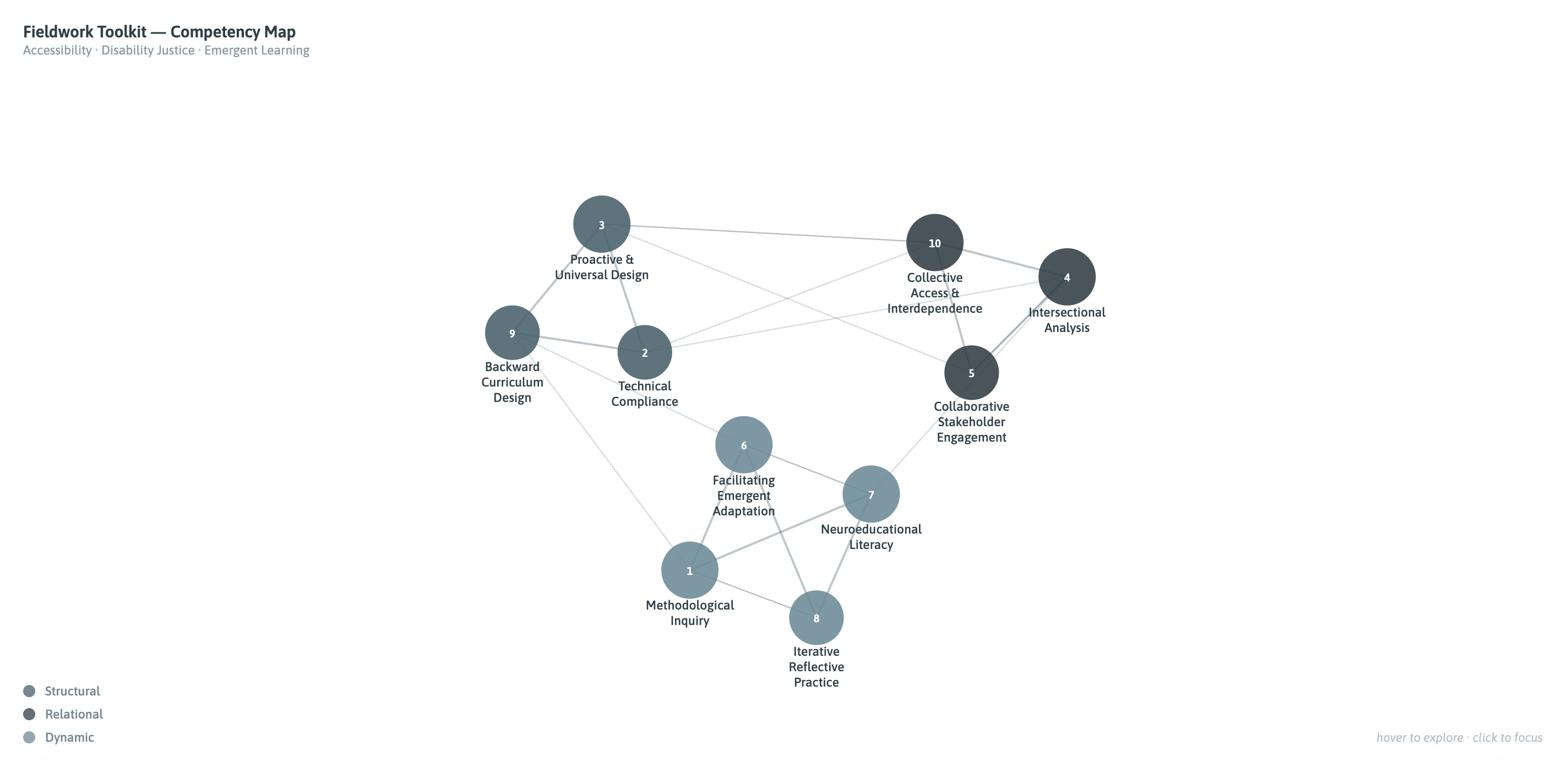
Interactive version — explore the full competency map at accessiblelearninglabs.github.io/fieldwork-2026-competencies-node-map
Download the accessible text version of this map (fieldwork-toolkit-accessible.docx).
The core idea
Knowledge only moves as far as the systems built to carry it.
That principle underpins everything shared in this series. If our infrastructure isn’t accessible, even the best intentions can’t reach everyone. If our teaching is too rigid, our systems can become barriers rather than bridges. Each cluster of competencies exists to support and reinforce the others.
Three clusters, one integrated approach
Structural: building the foundation
Competencies 2, 3, and 9 — Technical Compliance, Proactive and Universal Design, and Backward Curriculum Design — provide the base.
This is often where designers start, and sometimes where they stop. But when you bring these together, it’s not just about meeting standards like WCAG 2.1 or the Accessible Canada Act. It’s about starting with the end in mind — real participation and meaningful change — and designing every step backward from that goal. Universal Design for Learning is the blueprint.
Relational: centering those who are most affected
Competencies 4, 5, and 10 — Intersectional Analysis, Collaborative Stakeholder Engagement, and Cultivating Collective Access — are where our ethical commitments come to life.
Here, we move away from designing for a generic learner and instead work with real people whose lives, identities, and resources are complex and specific. For example, a low-income adult learner in a region with unreliable internet faces a different set of challenges than someone experiencing a single barrier. Collective access, where communities support each other through mutual aid and shared resources, only becomes possible when we do the intersectional work first.
For those interested in learning more about the concept of intersectionality, I highly recommend watching this short video featuring Kimberlé Crenshaw, the scholar who originally coined the term. In this engaging talk, Crenshaw explains how intersectionality helps us understand the overlapping and interconnected nature of social identities, and why recognising these intersections is essential for creating truly inclusive environments.
Watch Kimberlé Crenshaw’s introduction to intersectionality
Dynamic: keeping learning responsive and alive
Competencies 1, 6, 7, and 8 — Methodological Inquiry, Facilitating Emergent Adaptation, Neuroeducational Literacy, and Iterative Reflective Practice — ensure the system stays responsive.
This is the space for practitioner-researchers — those who pay attention to real-time signals from learners and adapt as needed. Maybe you notice cognitive fatigue in week three and decide to change things up, not because the plan was wrong, but because what you observe from learners matters more than a rigid curriculum. Neuroplasticity isn’t just a buzzword here; it’s a tool. Practices like spaced repetition, active learning, and ongoing reflection are essential to how learning unfolds.
Why the connections matter
Collective access depends on technical compliance. Sustained, adaptive learning relies on reflective practice. And equitable design requires an intersectional lens that recognises everyone in the room and what they’re experiencing.
This is what sets a practitioner-researcher apart from someone who simply delivers content: the ability to hold the structural, relational, and dynamic parts together all at once.
What’s next
The rest of this series will dig deeper into each cluster. If you’re already working in this space, you’ll see ideas you recognise, some you might name differently, and others you may still be developing. That’s intentional. This toolkit is meant as a starting point for shared exploration.
There’s more fieldwork ahead, and I look forward to learning with you.